

The Style CGI-Low Emission has a modified sealing element which is outside the compression clause of current ASME B16.20. Stiffness of the sealing element and filler protrusion is modified, all other aspects comply.

A Flexitallic® Distributor
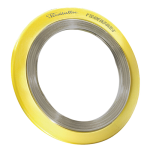 Spiral Wound Gasket utilizing an external ring which accurately centers gasket on flange face. The Style CG provides additional radial strength to prevent gasket blowout and acts as a compression stop. A general purpose gasket suitable for use with flat face and raised face flanges.
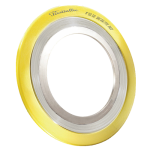


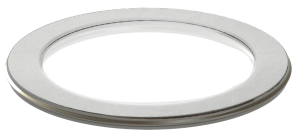 The Style R gasket consists of additional plies of metal used at the start and termination of the winding process improving stability and sealing performance. Basic construction type. Inner and outer diameters are reinforced with several plies of metal without filler to give greater stability and better compression and sealing characteristics. Suitable for tongue and groove or male and female or grooved to flat face flange assemblies.
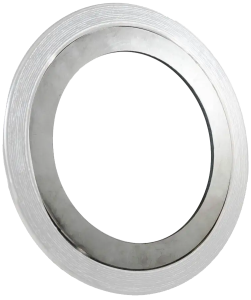 Spiral Wound Gasket Style RIR designed for use on heat exchangers where limited sealing areas are available, with PTFE filler material.Solid inner metal ring acts as a compression stop and fills the annular space between flange bore and the inside diameter of the gasket. Designed to prevent accumulation of solids, reduce turbulent flow at process fluilds and minimize erosion at flange faces. Suitable for male and female pipe flanges.


Thermiculite® 835 is a critical service gasket designed for use in applications involving high temperatures and/or aggressive chemical media. It is comprised of a spirally wound sealing element composed of a metal winding wire in combination with a vermiculite based filler material.
The gasket can be supplied with inner and/or outer centering/compression stop rings or in sealing element form. The spiral construction provides excellent sealing performance and confers high levels of gasket resilience.
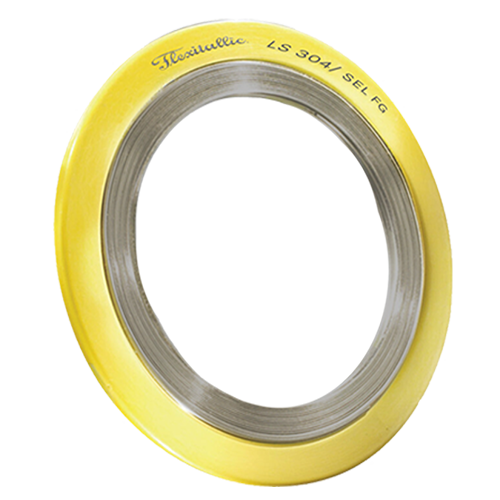
 Spiral Wound Gasket Style LS® (Low Stress) has been designed in such a way that compression and sealing requirements are achieved under very low seating stress.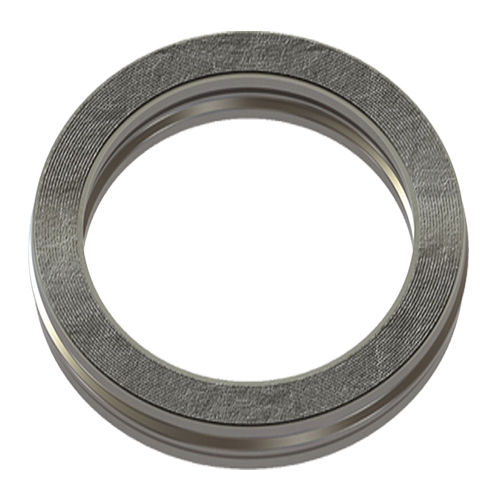
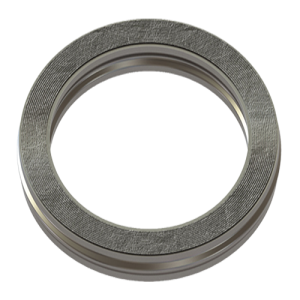 Style 625 for clamp-type and other non-standard flange assemblies. Style 625 gaskets were originally designed by Flexitallic for clamp type closures in aircraft, but are now widely used wherever space limitations indicate the need for a wafer-thin or narrow spiral wound gasket. The spiral wound gaskets are similar to style R gaskets, except original thickness is 0.0625″. These gaskets are widely used wherever space restrictions indicate the need for a wafer thin gasket design capable of sealing high pressures.
FLEXICARB®
A high purity flexible graphite with no binders or fillers. It exhibits superior sealability, and excellent resistance to a wide range of chemicals. Its unique combination of low permeability, inherent lubricity, and compressibility make FLEXICARB® suitable for critical gas and vacuum service. Leachable chloride content of industrial grade FLEXICARB® is 100 ppm maximum. Available in industrial, nuclear or corrosion inhibitor grades.
POLYTETRAFLUOROETHYLENE (PTFE)
PTFE is used as a filler material in Flexitallic gaskets where extreme chemical inertness is required. PTFE is unaffected by any known chemicals except molten alkali metals and fluorine precursors. Because of its low permeability, PTFE is also frequently used as a filler material on FLEXITALLIC gaskets in vacuum applications. Gaskets wound with PTFE should be fully confined either by fitting in a groove or providing both an external and internal ring.
THERMICULITE™
Filler material for use in applications with temperatures as high as 1600°F where graphite material is susceptible to oxidation. Thermiculite’s sealability is by far superior to mica or ceramic. Wide range of chemical compatibility of Thermiculite makes it suitable for harsh applications such as nitric acid and high temperature NOx gases.